

Surat Real Estate in 2026: Why the Next Opportunity Is Becoming More Location-Specific
Surat’s real estate market is entering a more selective phase. As premium housing holds its ground, infrastructure reshapes connectivity and commercial demand strengthens, the real opportunity is increasingly about choosing the right micro-market—not simply buying in the right city.
Surat’s Real Estate Story Is Becoming More Selective
Surat’s real estate market is no longer a single, city-wide growth story. In 2026, the market is becoming increasingly micro-market driven, with premium locations, infrastructure corridors and employment-led zones behaving differently from the broader market.
Recent market data points to a familiar pattern across Indian real estate: transaction volumes can moderate while property values remain resilient, particularly in premium segments where supply is more disciplined.
For buyers and investors, this changes the question from “Is Surat real estate a good investment?” to a more important one:
“Which location, asset and demand driver will create the strongest value over the next 3–5 years?”
1. Premiumisation Is Changing Buyer Behaviour
The premium segment continues to attract buyers who are increasingly willing to pay for better location, larger homes, superior specifications, amenities and established neighbourhoods.
In Surat, established premium corridors such as Vesu, Piplod, VIP Road and parts of Dumas Road continue to command stronger pricing because buyers are not purchasing only square footage—they are purchasing location quality, lifestyle and scarcity.
This is an important distinction for investors. A property with a stronger underlying location and limited comparable supply can potentially retain demand better than a cheaper property in an oversupplied micro-market.
2. Infrastructure Is Creating New Investment Corridors
Surat is undergoing a significant connectivity transformation.
The Surat Metro is one of the most important long-term infrastructure catalysts, with a planned network of approximately 40 km connecting major residential, commercial and emerging development corridors. Trial operations have already begun on part of the network.
The investment implication is not simply that every property near a metro station will appreciate.
The more relevant question is:
What kind of demand will the infrastructure unlock?
Improved connectivity can strengthen residential absorption, retail activity, office demand and rental markets—but the impact will vary significantly from one micro-market to another.
That is why we believe infrastructure proximity should be analysed alongside existing demand, development quality, accessibility and future supply.
3. Commercial Real Estate Is Becoming an Important Counterbalance
While residential markets are becoming more selective, commercial real estate continues to benefit from occupier demand.
Surat's commercial market is seeing stronger interest in quality office spaces, corporate leasing and well-positioned commercial assets. Demand is increasingly influenced by businesses seeking better accessibility, parking, building quality and professionally managed premises.
For investors, this creates an important opportunity beyond traditional residential property.
The right commercial asset can potentially provide a combination of:
Rental Income + Capital Preservation + Long-Term Appreciation
However, headline rental yield alone should never determine the purchase. Tenant quality, lease tenure, escalation clauses, vacancy risk, building quality and exit liquidity matter equally.
4. The Industrial & Logistics Story Deserves Attention
Surat's economic ecosystem extends well beyond residential development.
Textiles, manufacturing, logistics, trade and industrial activity continue to create demand for warehouses, industrial sheds, logistics facilities and strategically located land.
This makes the Sachin–Palsana–Kadodara belt and other industrial corridors increasingly relevant for investors looking beyond conventional residential assets.
The key investment principle here is simple:
Follow employment and business activity—not just announced infrastructure.
Where businesses expand, supporting commercial and residential demand tends to follow.
5. What Smart Investors Should Look For
In our view, the strongest opportunities in Surat over the next few years are likely to come from assets where three factors intersect:
Location + Demand + Future Connectivity
Before investing, we recommend evaluating:
Existing end-user or occupier demand Upcoming infrastructure and actual execution timelines Competing supply and future launches Rental potential and tenant profile Developer credibility and project execution Entry price relative to comparable properties Exit liquidity Regulatory and title documentation Potential for long-term capital appreciation
The objective should not be to buy the property that looks cheapest today.
The objective is to identify the asset that is most likely to remain desirable tomorrow.
Our View
Surat remains a market with multiple structural growth drivers, but 2026 is increasingly a year for selective real estate investing.
Premium residential corridors are benefiting from scarcity and lifestyle-led demand. Commercial assets are gaining importance as businesses seek better-quality spaces. Industrial and logistics corridors are supported by Surat's broader economic ecosystem. Meanwhile, infrastructure is gradually changing the location map.
For investors, this creates a broader opportunity set—but also demands better analysis.
At VARDHMAAN REALTORS, we believe the next phase of Surat real estate will not be about buying more property. It will be about buying the right property, in the right micro-market, at the right entry point.
Want a view on your own portfolio or requirement?
Our advisors take one call at a time — no gatekeeping, no scripts.
Send an enquiry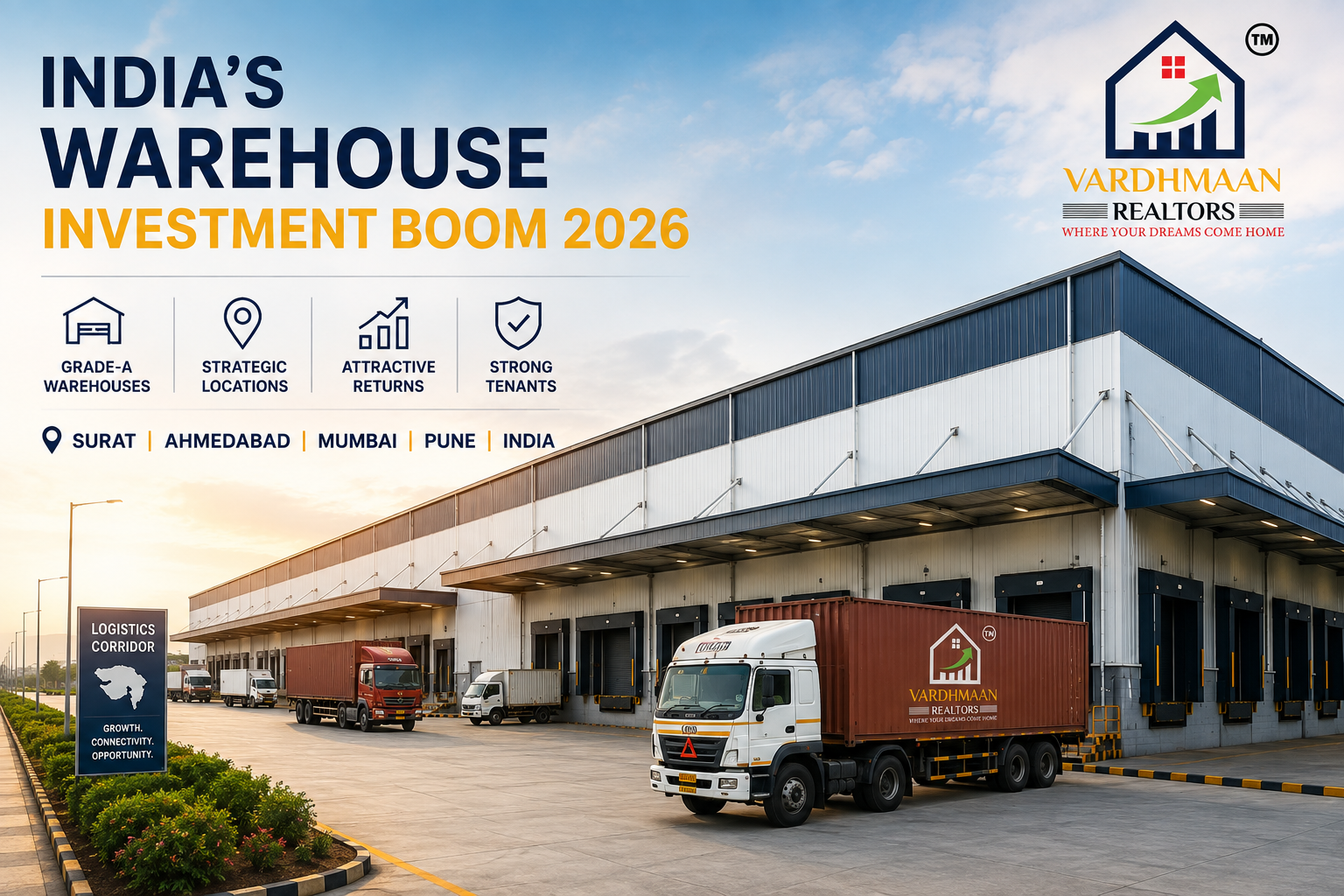
India’s Warehouse Investment Boom: Where Are the Next High-Growth Logistics Markets?
India’s warehousing market is evolving from a traditional storage segment into a significant real-estate investment opportunity. Record leasing, 3PL expansion, e-commerce, manufacturing, quick commerce and supply-chain formalisation are creating structural demand. But the real opportunity lies in identifying the right city, corridor, tenant and asset before the market becomes fully priced.

Why Warehousing Could Be One of India’s Most Attractive Real Estate Investment Opportunities for the Next Decade
India’s warehousing sector is moving from fragmented storage facilities to a professionally managed, technology-enabled real estate asset class. With e-commerce, 3PL, manufacturing, quick commerce and supply-chain expansion driving demand, the opportunity is increasingly shifting toward Grade-A warehouses in strategic logistics corridors — offering investors the potential combination of rental income, escalation and long-term capital appreciation.