
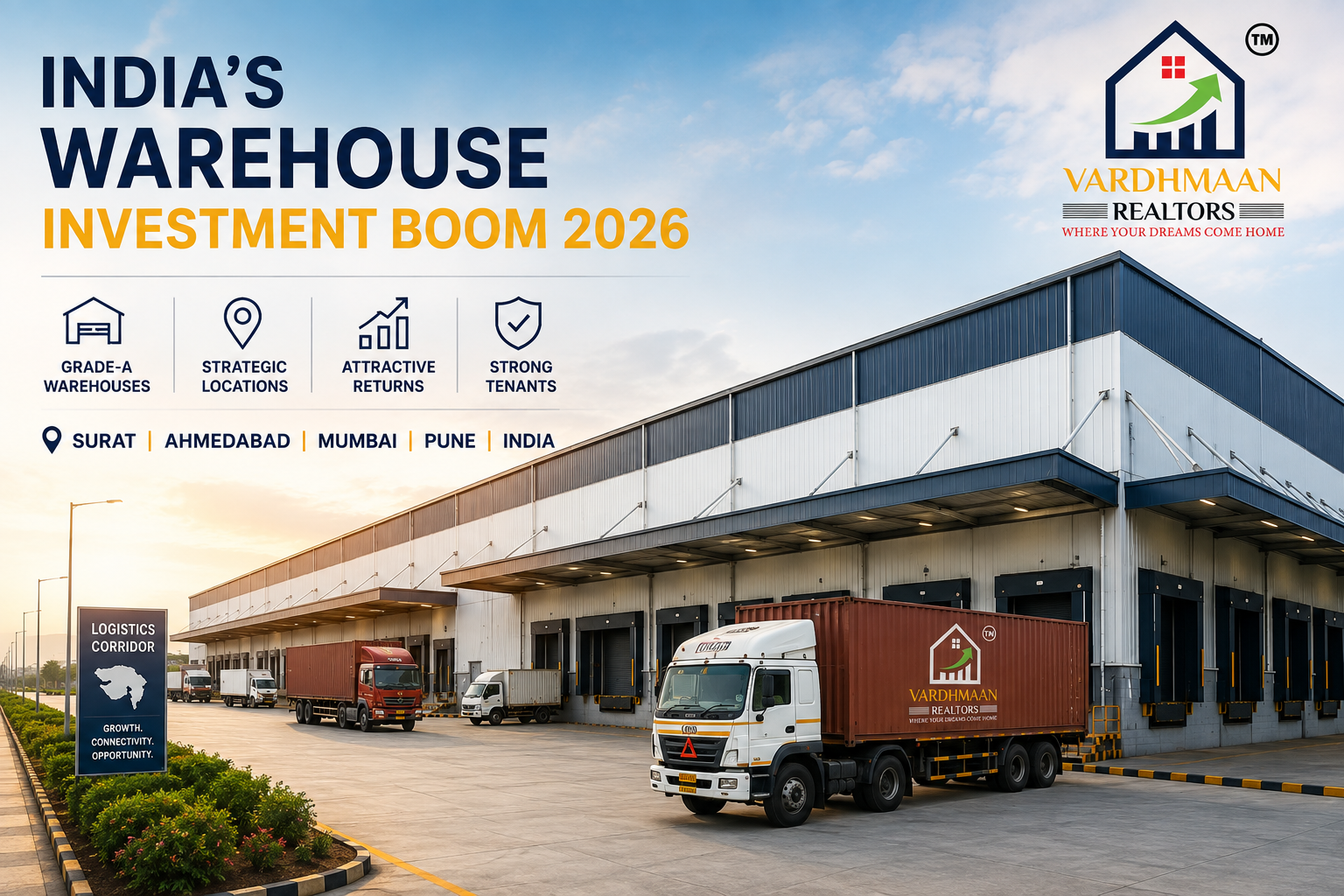
India’s Warehouse Investment Boom: Where Are the Next High-Growth Logistics Markets?
India’s warehousing market is evolving from a traditional storage segment into a significant real-estate investment opportunity. Record leasing, 3PL expansion, e-commerce, manufacturing, quick commerce and supply-chain formalisation are creating structural demand. But the real opportunity lies in identifying the right city, corridor, tenant and asset before the market becomes fully priced.
India’s Warehouse Investment Boom: Where Are the Next High-Growth Logistics Markets?
India’s next real-estate opportunity may not have a luxury lobby or a skyline view — it may have a loading dock.
For decades, Indian real-estate investors have primarily focused on residential apartments, commercial offices, retail properties and land. Warehousing was largely viewed as an operational requirement rather than an investment asset.
That is changing.
India's logistics and industrial real-estate market recorded 36.2 million sq. ft. of gross leasing across the top eight cities in H1 2026, the highest first-half leasing volume recorded. Leasing grew 18% year-on-year, while warehousing accounted for 24.3 million sq. ft., or 67% of total activity. These figures highlight the growing importance of logistics real estate within India's broader property market.
The opportunity is becoming increasingly structural, supported by third-party logistics, manufacturing, automotive, e-commerce, organised retail and evolving supply chains.
For investors, however, the question is not simply whether warehousing is growing.
The more important question is: where can a warehouse generate an attractive risk-adjusted return over the next five to ten years?
Why Warehousing Is Becoming an Investment Asset
Modern warehousing is increasingly becoming a form of real-estate infrastructure.
Today's institutional-grade warehouses can include high clear heights, modern flooring, high floor-loading capacity, multiple loading docks, fire and safety systems, large truck circulation areas, adequate parking, power infrastructure and strategic highway connectivity.
This creates an important transition from a traditional storage building to income-producing infrastructure.
For investors, professionally developed assets can potentially attract stronger occupiers, command better rentals and offer stronger long-term exit prospects.
However, asset quality alone does not make an investment attractive. The acquisition price, rental income, tenant strength, lease structure and future supply must all be evaluated together.
What Is Driving India's Warehouse Demand?
Third-party logistics is one of the strongest demand drivers.
3PL companies accounted for approximately 34% of H1 2026 logistics and industrial leasing across India's leading markets. Their growth is closely connected to e-commerce, organised retail, manufacturing and companies increasingly outsourcing their logistics operations.
Manufacturing is another major driver.
Engineering and manufacturing companies represented approximately 28% of H1 2026 leasing activity. Automotive companies also accounted for a significant share of demand, demonstrating that warehousing is increasingly connected to India's broader manufacturing and supply-chain expansion.
E-commerce is creating another layer of demand.
As online consumption increases, companies need strategically located distribution centres and fulfilment facilities to reduce delivery times and improve inventory efficiency.
Quick commerce is potentially even more transformative.
The traditional model of one large warehouse serving a large geographical area is increasingly being supplemented by regional fulfilment centres, urban warehouses and last-mile facilities.
This means the future warehouse market will increasingly be about location, accessibility and proximity to demand rather than simply warehouse size.
India's Major Warehouse and Logistics Markets
Delhi NCR remains one of India's most important logistics markets because of its enormous consumption base, large population, industrial ecosystem and extensive highway connectivity.
Chennai is particularly important because of its combination of manufacturing, automotive, ports, industrial corridors and export activity.
Pune benefits from a diversified economic base combining automobile manufacturing, engineering, IT, industrial activity and a large consumer market.
Mumbai and the wider MMR remain strategically important because of their enormous consumption base, ports, established logistics ecosystem and limited land availability. However, high land and property values mean investors must carefully evaluate whether rental yields justify the acquisition price.
Bengaluru has benefited from technology, GCCs, e-commerce, manufacturing and a large urban population. Its warehouse market is increasingly influenced by both regional distribution and urban consumption.
Ahmedabad is emerging as an important logistics and industrial market because of Gujarat's manufacturing ecosystem, highway connectivity, regional consumption and proximity to the wider Ahmedabad-Gandhinagar-GIFT City economic region.
Hyderabad also remains an important market supported by IT, GCCs, manufacturing, e-commerce and expanding urban demand.
Surat: An Important Market to Watch
Surat deserves separate consideration in India's warehouse investment landscape.
The city's economy is supported by textiles, diamonds, manufacturing, trading, distribution and a large regional consumption base.
This creates multiple potential warehouse demand segments.
Local distribution facilities can serve Surat's growing consumption market.
Regional distribution facilities can serve Gujarat and neighbouring states.
Industrial warehouses can support manufacturing and industrial occupiers.
E-commerce and organised retail can create additional requirements for fulfilment and last-mile logistics.
The important point for investors is that Surat should not be evaluated only as a residential real-estate market.
Its industrial and commercial ecosystem creates a separate investment thesis around warehouse, industrial, commercial and selected land opportunities.
How to Evaluate Warehouse ROI
One of the most common mistakes investors make is focusing only on the advertised rental yield.
For example, assume a warehouse is purchased for ₹5 crore and generates annual rent of ₹40 lakh.
The headline gross rental yield would be 8%.
However, the investor may still have to account for property tax, maintenance, insurance, repairs, vacancy, brokerage, management expenses and other ownership costs.
If net annual income after these costs is ₹32 lakh, the effective net rental yield becomes 6.4%.
This distinction is critical.
A property offering an apparently attractive gross yield may not necessarily produce an attractive net return.
Rental Yield Is Only One Part of the Return
Warehouse investment should be evaluated through multiple return components.
The first is gross rental yield, calculated using annual gross rent against the total acquisition cost.
The second is net rental yield, which considers the actual income remaining after operating expenses and vacancy.
The third is rental escalation. A long-term lease with contractual escalation can materially change the investment's income profile over time.
The fourth is capital appreciation.
The fifth is IRR, or Internal Rate of Return, which considers the timing of the initial investment, rental cash flows, expenses, financing and eventual sale.
This makes IRR particularly useful when comparing warehouse investment with commercial office, retail, residential or industrial land.
Warehouse vs Industrial Land
Warehouse and industrial land serve different investment objectives.
A warehouse can provide immediate rental income when leased to a suitable occupier. Industrial land generally provides limited or no rental income unless developed or otherwise income-producing.
Warehouse investment therefore tends to suit investors looking for a combination of income and appreciation.
Industrial land may suit investors with a longer holding period who are primarily targeting land appreciation or future development potential.
Neither is automatically superior.
The right choice depends on acquisition price, location, development potential, expected income, holding period and exit strategy.
Grade-A vs Grade-B Warehouses
Grade-A warehouses generally offer better specifications, stronger infrastructure, improved operational efficiency and greater appeal to institutional occupiers.
The flight toward quality is an important trend in India's logistics market.
However, Grade-A does not automatically mean better investment returns.
If a Grade-A warehouse is purchased at an excessive valuation, its rental yield may be lower than that of a well-located Grade-B asset acquired at a more attractive price.
The investor should therefore evaluate asset quality and acquisition valuation together.
What Makes a Warehouse Investment Attractive?
The first factor is location.
Investors should evaluate highway connectivity, industrial clusters, city access, labour availability and truck movement.
The second factor is asset quality.
Clear height, floor loading, docking infrastructure, fire compliance, power, parking and truck circulation can directly influence tenant demand.
The third factor is tenant quality.
A warehouse leased to a financially strong corporate or established 3PL operator is fundamentally different from one leased to a weak or unproven tenant.
The fourth factor is lease quality.
Investors should examine lease tenure, lock-in period, rental escalation, security deposit, renewal provisions, maintenance obligations and exit clauses.
The fifth factor is valuation.
Even an excellent warehouse can become a poor investment if the purchase price is too high relative to achievable rent.
Where Could the Next Opportunity Come From?
Investors should look beyond today's largest logistics markets and identify locations where multiple growth drivers are converging.
The most interesting markets may combine infrastructure development, manufacturing expansion, rising consumption, logistics demand, land availability and occupier expansion.
Established markets such as Delhi NCR, Mumbai/MMR, Bengaluru, Chennai and Pune offer deep occupier ecosystems.
Emerging markets such as Ahmedabad, Surat and Hyderabad can offer different combinations of growth, industrialisation and logistics demand.
The opportunity should therefore be analysed at the corridor level rather than simply at the city level.
The Future of Indian Warehousing
Several structural trends are expected to influence the sector over the next five to ten years.
E-commerce should continue increasing the requirement for distribution and fulfilment facilities.
Quick commerce can create demand for increasingly decentralised inventory and urban fulfilment locations.
Third-party logistics can continue expanding as companies outsource supply-chain operations.
Manufacturing growth can create additional industrial and logistics requirements.
Automotive and EV supply chains can generate demand around manufacturing clusters.
Organised retail can increase regional distribution requirements.
Technology and automation can further increase the importance of modern Grade-A facilities.
Institutional capital is also increasingly entering the logistics sector, which can accelerate the development and professionalisation of India's warehouse ecosystem.
Risks Warehouse Investors Should Consider
Warehouse investment is not risk-free.
Location risk can arise when a property lacks efficient connectivity despite being marketed as a logistics location.
Tenant risk is important because the quality and financial strength of the occupier directly influence rental security.
Lease risk arises when lock-in periods are short or rental escalation is weak.
Vacancy risk becomes important when competing warehouse supply increases.
Supply risk can affect rental growth and occupancy.
Valuation risk occurs when investors pay a high price for a relatively low rental yield.
Liquidity risk must also be considered because selling a specialised industrial asset can take longer than selling a more liquid residential property.
Financing risk is particularly relevant for leveraged investors because changes in borrowing costs can significantly affect cash-on-cash returns.
VARDHMAAN REALTORS Investment Framework
At VARDHMAAN REALTORS, we believe warehouse investments should ultimately be evaluated across several dimensions rather than a single rental-yield figure.
These include location quality, tenant strength, lease quality, rental yield, capital appreciation potential, infrastructure, competing supply, asset quality and exit liquidity.
The objective is to identify opportunities where current income and future appreciation are supported by genuine underlying demand.
VARDHMAAN REALTORS View
India's warehouse investment opportunity should be evaluated as income-producing real-estate infrastructure rather than simply another commercial property.
The strongest opportunities are likely to emerge where multiple demand drivers converge: manufacturing, consumption, e-commerce, third-party logistics, infrastructure and employment.
For investors, the objective should not be to chase the highest advertised rental yield.
The objective should be to identify sustainable net income, a quality tenant, appropriate entry valuation, rental escalation, capital appreciation potential and credible exit liquidity.
Surat, Ahmedabad, Pune, Chennai, Delhi NCR, Bengaluru and selected MMR corridors each offer different investment theses.
The right market ultimately depends on the investor's capital, required income, risk tolerance, holding period and investment objective.
In warehousing, the building matters.
But the location, tenant and lease often matter even more.
Conclusion -
India's warehouse sector has moved beyond being a niche industrial segment.
Record leasing activity, 3PL expansion, manufacturing growth, e-commerce, quick commerce and supply-chain formalisation are creating structural demand for modern logistics infrastructure.
The next generation of warehouse investors will need to think less like traditional property buyers and more like investors evaluating cash flow, tenant quality, lease durability, supply, infrastructure, valuation and exit potential.
The key question is no longer:
"How much rent does this warehouse give?"
The better question is:
"What risk-adjusted return can this warehouse generate over my investment horizon?"
##Looking for a warehouse or industrial property as an investment?
VARDHMAAN REALTORS helps investors evaluate opportunities across Surat, Ahmedabad, Mumbai/MMR, Pune, GIFT City and other major Indian markets based on location, tenant quality, lease structure, rental economics, future demand and investment potential.
Speak to a VARDHMAAN REALTORS Investment Advisor.
Want a view on your own portfolio or requirement?
Our advisors take one call at a time — no gatekeeping, no scripts.
Send an enquiry
Surat Real Estate in 2026: Why the Next Opportunity Is Becoming More Location-Specific
Surat’s real estate market is entering a more selective phase. As premium housing holds its ground, infrastructure reshapes connectivity and commercial demand strengthens, the real opportunity is increasingly about choosing the right micro-market—not simply buying in the right city.

Why Warehousing Could Be One of India’s Most Attractive Real Estate Investment Opportunities for the Next Decade
India’s warehousing sector is moving from fragmented storage facilities to a professionally managed, technology-enabled real estate asset class. With e-commerce, 3PL, manufacturing, quick commerce and supply-chain expansion driving demand, the opportunity is increasingly shifting toward Grade-A warehouses in strategic logistics corridors — offering investors the potential combination of rental income, escalation and long-term capital appreciation.